




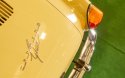
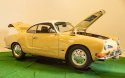
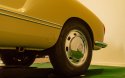


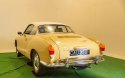


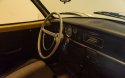
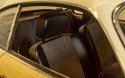
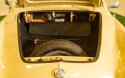
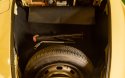
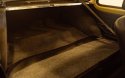
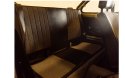
This stunning example of a 1971 Pampas Yellow Karmann Ghia is part of, “The Theochari Collection”, and has lived a cherished life.It started its life in California until 1999 and now it resides on the sunny North Devon coastline. Where will it go next?
Its powered by a nice 1600 cc twin port. It is certainly a car that will turn heads and start conversations wherever you go with a fantastic story to be told over and over again.
The following is an excerpt from the original brochure , we found online, but really exudes the charm of a Karmann Ghia.
If you want a racy, hand-finished body, you go to a racy, hand-finished body designer. Which we did: The Ghia Studios of Turin, Italy.
The Ghia design was, as you can see, quite beautiful. And, like most quite beautiful designs, impractical. With all its subtle curves and intricate lines, the Karmann Ghia couldn't be produced on a conventional mass production line.
So it's made instead on an unconventional, limited production line.
At the Karmann Coachworks in Osnabrück, Germany. Where, a century ago, artisans made coaches for European nobility. Before coaches had engines in them. Here, at a maddeningly slow pace, Ghia's ideas take shape.
To make sure they take exactly the shape Ghia had in mind, Karmann employs 16 sculptors.
The sculptors' job is to create the graceful, sloping lines that machines can't. At the corners of the windshield, for example. Or the gentle curve of the rear. Using molten pewter and a beechwood tool, the sculptors fidget with the body until it's right. Which is one reason why, on a good day, only 120 Karmann Ghias leave the factory. When the sculptors aren't sculpting, Karmann's other coachmakers are coachmaking.
To create the intricate curves around the head lights, for example, they make each front fender in
two parts and then weld them together by hand. Then they shape each fender. By hand. Then they weld each fender to the body. By hand.
After the body is sculpted and formed, Karmann's coachmakers start to finish it.
The finish consists of four coats of anti-corrosives. primers, and paint. With lots of rubbing and sanding in between.
But even after it's finished, it's still not finished.
To make absolutely sure everything went the way Ghia wanted, every body is inspected by Karmann's ingenious quality control system. Fussy men with sensitive fingers.
Karmann has 240 such inspectors, and their job is to nit-pick. Wearing mittens, they run their hands along the finished bodies. If there are any nits left, the inspectors will pick them.
And to make sure the 240 Karmann inspectors don't miss anything, Volkswagen keeps 16 of its own inspectors around. Their job: to inspect the Karmann inspectors.
That, in brief, is what a body has to go through before it gets racy and hand finished enough for the Karmann Ghia.
With all the fussing and fidgeting, it has to be one of the worst ways imaginable to get rich quick in the automobile business.
But then, if it weren't for the fussing and fidgeting,
it wouldn't be a Karmann Ghia.
This stunning epitome of a time when cars were crafted could be yours for just £16995.
We’re based in North Devon & can provide further photos or videos & can assist with shipping nationally or internationally. Unless of course you would like to arrange a short break to one of the most beautiful parts of the UK & visit the UKs only Volks Museum & Showroom, displaying over 85 classic Volkswagens & enjoy a relaxing lunch in our cafe’.